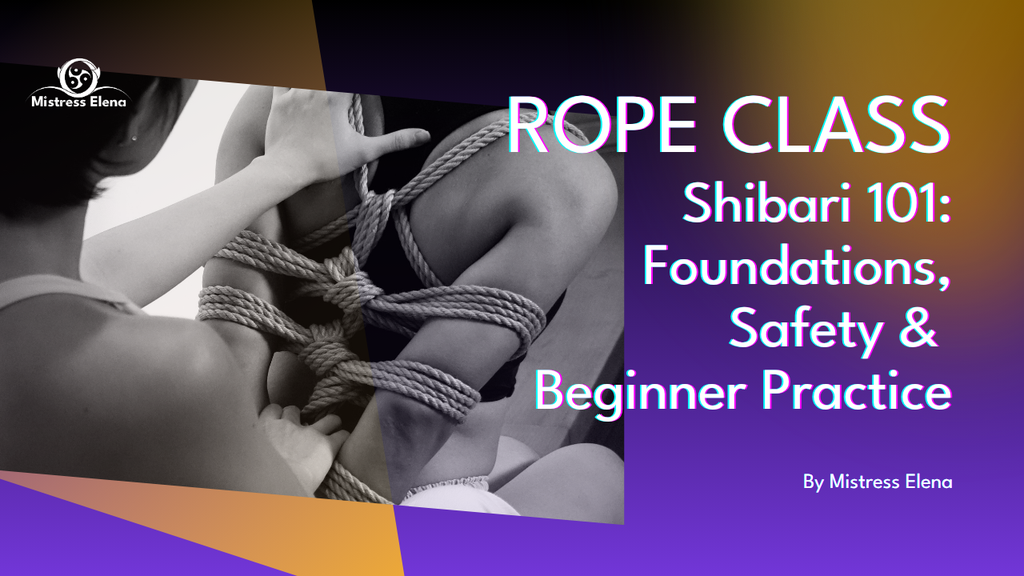
SHIBARI 101 COURSE - ROPE CLASS: Foundations, Safety & Beginner Practice (ENGLISH)
Shibari 101 – Foundations, Safety & Beginner Practice
Shibari 101 is designed for beginners, or for those who want to return to a solid foundation before moving into more complex structures.
This course does not prioritize aesthetics first.
Instead, we begin with what truly matters: understanding origins, safety principles, basic anatomy, and the roles and responsibilities of each participant within a scene.
THEORY – SAFETY FOUNDATION (ENGLISH)
The theoretical part of this course is delivered in English, focusing on essential knowledge to build a safe and responsible practice:
Historical context and evolution of Shibari
Core safety principles and risk awareness
Basic anatomy and high-risk areas to avoid
Consent, communication, and responsibility in rope play
Understanding physical and emotional responses (pain, subdrop/topdrop, aftercare)
PRACTICAL GUIDELINES / TUTORIALS (VIETNAMESE)
The practical section is guided in Vietnamese, offering step-by-step instructions that are clear, accessible, and beginner-friendly
The goal of Shibari 101 is not to make you “advanced” quickly, but to help you start correctly — with awareness, responsibility, and respect for the human body.
If you’re looking for a grounded, safe, and thoughtful entry point into Shibari, this course is where you begin.
| Người phụ trách | Mistress Elena |
|---|---|
| Cập nhật Lần cuối | 30/04/2026 |
| Thời gian hoàn thành | 6 giờ 10 phút |
| Thành viên | 1 |
11. ROPE CLASS - BUTTERFLY HARNESS TUTORIAL
🎥 Butterfly Harness – Balance, Expansion, and Symmetrical Beauty in Shibari
The Butterfly Harness is a variation of the chest harness that creates wing-like shapes across the front or back of the upper body, evoking the sense of expansion and the soft movement of butterfly wings. This tie focuses on symmetry, clean lines, and balanced tension across both sides of the body.
THEORY – SAFETY FOUNDATION (ENGLISH)
Xem tất cảConclusion & Disclaimer – Shibari 101
The final section of the Shibari 101 course summarizes the core principles of Shibari safety, consent, risk management, and aftercare, while reinforcing the importance of responsible practice in BDSM.
The disclaimer clarifies that this course is intended for educational and safety guidance purposes only, and does not replace in-person training or professional medical advice. Participants are expected to assess their own capabilities, practice within safe limits, and take responsibility for their choices.
This closing section serves as an essential step in helping you approach rope bondage and Shibari with awareness, responsibility, and long-term safety.
Episode 1 – Shibari 101: Safety Foundations in Rope Bondage
Episode 1 of the Shibari 101 course focuses on essential knowledge and safety practices for beginners learning Shibari. The content includes: the origins of Shibari (hojojutsu – kinbaku), the principles of RACK and SSC, the roles of the Rope Top (Rigger) and Bunny, how to choose rope materials (jute, hemp, cotton, nylon), rope handling and maintenance, as well as the mandatory use of emergency cutting tools.
This is the foundational step to help you understand Shibari safety, rope safety, consent, and responsibility in BDSM before moving into practical tying techniques.
Shibari 101 is an introductory course designed for beginners, focusing on safety, consent, and the fundamental foundations of rope bondage.
You will learn about the origins of Shibari, the roles of the Rigger and Bunny, how to choose and handle rope, basic anatomy, high-risk areas, risk management, subdrop and topdrop, as well as aftercare.
This course helps you approach Shibari with awareness, responsibility, and safety from the very beginning.
PRACTICAL GUIDELINES (Vietnamese)
Xem tất cả🎥 Butterfly Harness – Balance, Expansion, and Symmetrical Beauty in Shibari
The Butterfly Harness is a variation of the chest harness that creates wing-like shapes across the front or back of the upper body, evoking the sense of expansion and the soft movement of butterfly wings. This tie focuses on symmetry, clean lines, and balanced tension across both sides of the body.
🎥 Armbinder / Strapado – Restraint, Surrender, and Control in Shibari
The Armbinder (also known as Strapado) is one of the most classic and intense behind-the-back ties in Shibari. When performed correctly, it creates a naturally restrictive position that expresses both surrender and deep trust, while highlighting the aesthetics of control and the limits of the body.
This technique requires solid safety knowledge and clear communication, as the shoulders, arms, and elbow joints are particularly vulnerable to injury if handled incorrectly.
🎥 Rope Joining – A Small Technique with Big Impact in Shibari
In Shibari, joining ropes may seem simple, but it is an essential skill to ensure the tying process remains smooth, safe, and aesthetically clean. A secure, neat, and easy-to-release knot helps maintain continuity throughout the scene without disrupting the emotional flow or rhythm between partners.
Ebook
Xem tất cả“Shibari 101: Hướng Dẫn An Toàn & Cơ Bản Cho Người Mới Bắt Đầu"
Tác giả: Mistress Elena
Một cẩm nang cơ bản dành cho những ai muốn bắt đầu hành trình với dây an toàn, tỉnh thức và đầy kết nối.
Shibari không chỉ là nghệ thuật trói buộc cơ thể, mà còn là cách lắng nghe, cảm nhận và thấu hiểu giữa hai con người qua từng sợi dây, hơi thở và nhịp đập. Tuy nhiên, vẻ đẹp ấy chỉ có thể tồn tại khi được đặt trên nền tảng của an toàn, đồng thuận và tôn trọng giới hạn.
Cuốn ebook này tổng hợp những kiến thức nền tảng về:
Nguyên tắc và trách nhiệm của rigger & rope bunny
Cách chọn và xử lý dây thừng
Kiến thức giải phẫu cơ bản, vùng nguy hiểm và cách phòng tránh chấn thương
Quản lý rủi ro, kiểm soát cơn đau và xử lý sự cố
Aftercare và khía cạnh tâm lý sau buổi trói
Đây không phải là tài liệu dạy trói, mà là bản đồ an toàn giúp bạn hiểu rõ cơ thể, cảm xúc và rủi ro trước khi bước vào thế giới của Shibari.
Shibari có thể là nghệ thuật, là khoái cảm, là thiền định, hay là cách kết nối sâu sắc với chính mình và người khác, nhưng trên hết, đó là hành trình của nhận thức và tự chịu trách nhiệm.