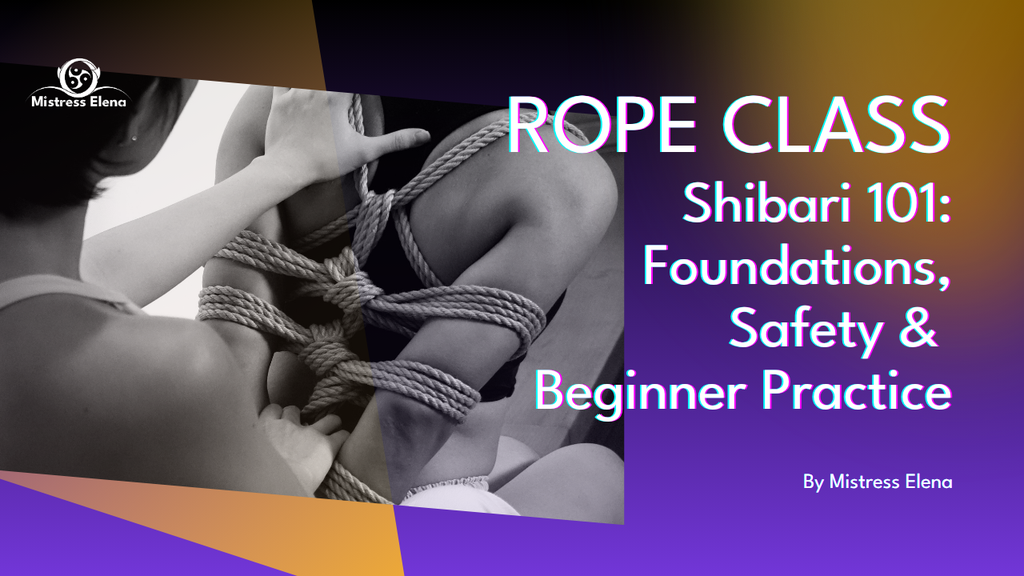
SHIBARI 101 COURSE - ROPE CLASS: Foundations, Safety & Beginner Practice (ENGLISH)
Shibari 101 – Foundations, Safety & Beginner Practice
Shibari 101 is designed for beginners, or for those who want to return to a solid foundation before moving into more complex structures.
This course does not prioritize aesthetics first.
Instead, we begin with what truly matters: understanding origins, safety principles, basic anatomy, and the roles and responsibilities of each participant within a scene.
THEORY – SAFETY FOUNDATION (ENGLISH)
The theoretical part of this course is delivered in English, focusing on essential knowledge to build a safe and responsible practice:
Historical context and evolution of Shibari
Core safety principles and risk awareness
Basic anatomy and high-risk areas to avoid
Consent, communication, and responsibility in rope play
Understanding physical and emotional responses (pain, subdrop/topdrop, aftercare)
PRACTICAL GUIDELINES / TUTORIALS (VIETNAMESE)
The practical section is guided in Vietnamese, offering step-by-step instructions that are clear, accessible, and beginner-friendly
The goal of Shibari 101 is not to make you “advanced” quickly, but to help you start correctly — with awareness, responsibility, and respect for the human body.
If you’re looking for a grounded, safe, and thoughtful entry point into Shibari, this course is where you begin.
| Người phụ trách | Mistress Elena |
|---|---|
| Cập nhật Lần cuối | 30/04/2026 |
| Thời gian hoàn thành | 6 giờ 10 phút |
| Thành viên | 1 |
16. ROPE CLASS - LILA VARIANT CHEST HARNESS TUTORIAL
🎥 Lila Chest Harness – An Elegant Variation of the Classic Body Harness
The Lila Chest Harness is a variation of the chest harness in Shibari, featuring soft, flowing rope patterns that contour the chest and upper body. This tie offers both structural stability and strong aesthetic appeal, making it ideal for body rope practice, photography, or transitioning into more advanced ties.
In this video, you will learn how to create a Lila Chest Harness variation in a clean, balanced, and safe way.
PRACTICAL GUIDELINES (Vietnamese)
Xem tất cả🎥 Lila Chest Harness – An Elegant Variation of the Classic Body Harness
The Lila Chest Harness is a variation of the chest harness in Shibari, featuring soft, flowing rope patterns that contour the chest and upper body. This tie offers both structural stability and strong aesthetic appeal, making it ideal for body rope practice, photography, or transitioning into more advanced ties.
In this video, you will learn how to create a Lila Chest Harness variation in a clean, balanced, and safe way.
🎥 The Gem Chest Harness – Precision, Balance, and Geometric Focus in Shibari
The Gem Chest Harness is a variation of the chest harness featuring a geometric focal point at the center of the chest, creating the impression of a “gem” held in place by symmetrical rope lines. This tie stands out for its clean structure, visual clarity, and high aesthetic value, making it suitable for both foundational practice and photography.
When executed correctly, the harness helps stabilize the upper body, keeps the rope aligned and flat, and distributes tension evenly while still allowing comfortable breathing. However, attention must be paid to pressure around the chest and under the arms, with continuous observation of the partner’s feedback to ensure safety.
🎥 Hishi Karada Variations – Geometry, Structure, and Full-Body Embrace in Shibari
Hishi Karada is a distinctive full-body tie characterized by diamond-shaped (hishi) patterns that wrap closely around both the upper and lower body. Variations of Hishi Karada can adjust the density of the pattern, anchor points, and pressure distribution to suit different aesthetic, sensory, or movement purposes.
This structure helps distribute tension evenly across the body, creating a sense of containment and stability while accentuating the natural curves of the torso. However, because the rope travels across sensitive areas such as the ribs, hips, and thighs, the practitioner must understand anatomy, avoid major nerve pathways, and continuously monitor circulation.
Hishi Karada variations are not only complex tying techniques, but also lessons in patience, precision, and ongoing communication between the rigger and their partner to ensure both safety and a complete experience.
🎥 Pretzel Knot – A Versatile and Secure Knot in Shibari
The Pretzel Knot is a highly versatile intermediate knot in Shibari, commonly used for rope joining or securing a section of rope between two points. It is easy to adjust, provides reliable friction, and can still be released quickly when needed.
The name “pretzel” comes from its distinctive twisted shape, resembling the pastry—symbolizing interweaving, connection, and soft control.
🎥 Armbinder / Strapado – Restraint, Surrender, and Control in Shibari
The Armbinder (also known as Strapado) is one of the most classic and intense behind-the-back ties in Shibari. When performed correctly, it creates a naturally restrictive position that expresses both surrender and deep trust, while highlighting the aesthetics of control and the limits of the body.
This technique requires solid safety knowledge and clear communication, as the shoulders, arms, and elbow joints are particularly vulnerable to injury if handled incorrectly.
🎥 Butterfly Harness – Balance, Expansion, and Symmetrical Beauty in Shibari
The Butterfly Harness is a variation of the chest harness that creates wing-like shapes across the front or back of the upper body, evoking the sense of expansion and the soft movement of butterfly wings. This tie focuses on symmetry, clean lines, and balanced tension across both sides of the body.
🎥 Heart Chest Harness – Connection, Aesthetics, and Openness in Shibari
The Heart Chest Harness is a variation of the chest harness (upper body tie), forming a heart shape across the chest as a symbol of connection and trust.
🎥 Hishi Karada – A Diamond Pattern Embracing the Body
Hishi Karada is a classic body harness in Shibari, forming diamond-shaped patterns that run along the body. Beyond its aesthetic and sensual appeal, it is also a study in tension balance, symmetry, and attunement to the body of the person being tied.
🎥 Double Column Tie – Connecting Two Points, Expanding Creative Possibilities
The Double Column Tie is a progression from the Single Column Tie, used to secure two limbs or two separate points together. This knot provides stability and balance, serving as a foundation for many Shibari positions from basic to advanced.
🎥 Single Column Tie – Your First Step into the World of Shibari
The Single Column Tie is a fundamental knot in Shibari, yet incredibly important. With just a single wrap of rope, it creates connection, control, and safety, serving as the foundation for more advanced tying techniques later on.
🎥 Rope Joining – A Small Technique with Big Impact in Shibari
In Shibari, joining ropes may seem simple, but it is an essential skill to ensure the tying process remains smooth, safe, and aesthetically clean. A secure, neat, and easy-to-release knot helps maintain continuity throughout the scene without disrupting the emotional flow or rhythm between partners.