
"Not every strong reaction comes from the present. Sometimes, what is reacting is a part of us that is still living in the past."
Have you ever reacted more strongly than you expected?
Perhaps you have experienced a situation like this: your partner replies to a message a few hours late and you immediately feel anxious, restless, even believing that they no longer care about you. A colleague gives feedback on your work and you spend the whole day blaming yourself. A friend becomes silent in a conversation and you start to think that you did something wrong. Or sometimes just a glance, a tone of voice, or a rejection is enough to make you angry, scared, or want to leave that situation immediately. To be honest, these are all things I have experienced myself, even many times and perhaps even more seriously.
The strange thing is that when everything passes, you look back and realize that your reaction seems much stronger than the event itself. You wonder: "Why did I react that way?" This is one of the most common questions I receive in psychological counseling, coaching, and education about BDSM. Most of us tend to assume that the cause lies in the recent event. But from the perspective of psychology and neuroscience, what is reacting may not be entirely the present, but an old experience that the nervous system has remembered for a long time.
What is a trigger?
In everyday life, the term trigger is often used to refer to anything that makes us uncomfortable or feel "touched". However, in psychology, trigger has a more specific meaning. A trigger is an external or internal agent that causes the nervous system to react strongly because it reminds us of a past experience that the brain has assessed as dangerous or threatening. It is important to understand that a trigger does not necessarily stem from a major event or a serious psychological trauma. Sometimes, being frequently criticized, ignored, not being listened to, having to suppress emotions, or always trying to be loved throughout childhood is enough to form automatic responses that last into adulthood.
Neuroscientist Joseph LeDoux, who has spent decades researching the role of the amygdala in processing emotions, shows that the brain can identify danger signals and activate survival responses in just a few milliseconds, much faster than the conscious thinking process of the prefrontal cortex. In other words, the body can react before we even understand what is happening. That is why many people, after calming down, say: "At that moment, I didn't know why I reacted that way."
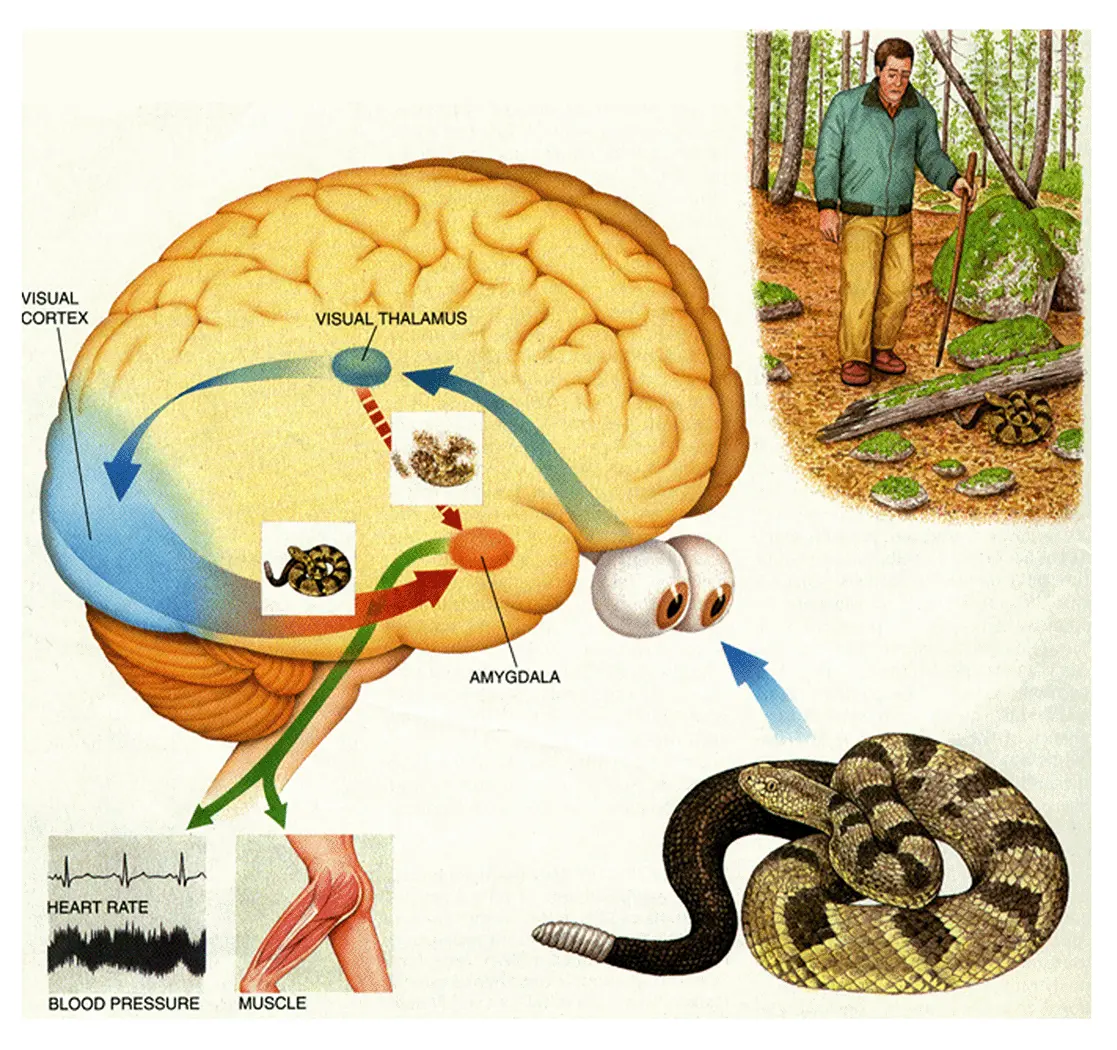
Trigger is not weakness
One of the most common misunderstandings is that if you are easily triggered, you are too sensitive or lack emotional control. In fact, neuroscience research shows the opposite. A trigger does not reflect a weakness in character but reflects how the nervous system has learned to protect you throughout development.
The human brain has evolved with one priority above all: to help us survive. If in the past an experience was accompanied by feelings of pain, rejection, or insecurity, the brain will remember the related signals to react faster next time. This is an adaptive mechanism that helped our ancestors detect danger before it was too late. However, in modern life, this mechanism sometimes causes us to react strongly to situations that are no longer truly threatening.
Psychiatrist Bessel van der Kolk, author of The Body Keeps the Score, argues that the body does not just store memories in the form of stories we can recall. It also retains memories in the form of sensations in the body, physiological responses, and protective patterns that once helped us survive. Therefore, a trigger is not evidence that you are weak. It shows that your nervous system is doing exactly what it is programmed to do: trying to keep you safe. Unfortunately, sometimes it is using a "map" of the past to react to the present.
A trigger does not mean the present is dangerous.
This is the most important point of the entire article. A trigger does not prove that the current situation is actually dangerous. It only indicates that the current situation bears similarities to an experience that the nervous system once recorded as dangerous.
For example, a partner replies to a message after five hours. That is just an objective event. They may be busy in a meeting, sleeping, driving, or simply need time for themselves. However, if you immediately feel panic, constantly check your phone, and believe you are about to be abandoned, then that reaction may not entirely stem from the message. It may relate to old experiences of being neglected, ignored, or growing up in an environment where the connection with caregivers was unstable.
According to the Attachment Theory of John Bowlby and Mary Ainsworth, early experiences contribute to the formation of "internal working models" about ourselves and others. These models influence how we interpret relationships in adulthood. Therefore, two people may face the same situation but have completely different reactions. The difference lies not in the event, but in the story that each person's nervous system is telling about that event.
Attachment Styles: The Invisible Compass in Every Relationship

Trigger is not the cause
A common mistake is that we often confuse trigger with cause. What causes us distress is often not the button itself, but what that button connects to.
Imagine the doorbell ringing. The sound of the bell does not create the house; it merely signals that something is behind the door. Trigger works in a similar way. The trigger today is just a signal. It is not the whole story.
If we only try to eliminate every trigger from our lives, we would have to avoid people, relationships, and many experiences. That is nearly impossible. What helps us grow is not a life without triggers, but the ability to pause and ask ourselves: "What from the past is being awakened right now?"
That is the moment the past touches the present. And it is also where the journey of self-awareness truly begins.
(to be continued)...